My research is rooted in a concern for whose voices shape the knowledge we produce. Alongside my academic work, I have been fortunate to develop sustained relationships with stroke survivors, carers, and community groups that have informed how I think about equity and inclusion in research.
This work began during my time at King’s College London, where I led patient and public involvement in our programme of research on using data to improve the lives of stroke survivors, working closely with stroke survivors and their family members over several years. Through this work, I began thinking about questions of how we involve stroke survivors in research, rather than the more common questions of when and in what.
Dr Sophie Rowland-Coomber and I worked with stroke survivors from the South London Stroke Research Patient and Family Group at KCL on some early work, focused on how we can make PPI meetings more accessible to stroke survivors with diverse impairments, particularly those with communication difficulties. This was funded by the NIHR ARC South London, and I wrote a blog post about it for the NIHR ARC South London blog. Following feedback from participating stroke survivors, Sophie and I also worked with them to produce the video below, which talks about and promotes the activities of the South London Stroke Research Patient and Family Group.My research is rooted in a concern for whose voices shape the knowledge we produce. Alongside my academic work, I have been fortunate to develop sustained relationships with stroke survivors, carers, and community groups that have informed how I think about equity and inclusion in research.
Dr Rowland-Coomber has also been exploring, and continues to explore, the experiences of stroke survivors in creative ways. The video linked here was produced as part of a photovoice project with stroke survivors celebrating thirty years of the South London Stroke Register, supported in part by the EquIPS project discussed below.
Together we have been working to expand the repertoire of (acceptable) tools and the thinking about how we involve stroke survivors in shaping research (patient and public involvement) and the ways we can incorporate their perspectives are research (as research participants). This is particularly important in interdisciplinary health research settings, where what counts as PPI, engagement and “qualitative research” can be narrowly understood. Researchers outside these settings have long used creative methods in their work where they are often met with greater acceptance.
EquIPS: Equity in Patient and Public Involvement in Stroke Research
EquIPS is an NIHR-funded Programme Development Grant that grows directly out of this work with stroke survivors. It starts from the position that stroke affects people in diverse ways, and that research involving stroke survivors should reflect that diversity in its methods and practices. Too often, patient and public involvement draws on a narrow range of voices — not because other stroke survivors don’t want to contribute, but because the methods researchers use don’t accommodate people with communication difficulties, cognitive changes, or other complex impairments.
EquIPS is working to change that. The project develops tools, resources and approaches that equip researchers to involve a wider range of stroke survivors in shaping research — from raising awareness that taking part is possible whatever the impacts of stroke, to developing methods that genuinely work for people with a wide range of needs. The more diverse the voices informing research, the more meaningful and relevant that research becomes.
We began by asking how stroke PPI is actually done. In Beyond the Meeting, published open access in Health Expectations, we report a national questionnaire of principal investigators on NIHR, UKRI and Stroke Association-funded stroke projects — 31 responses covering 104 of the 185 eligible projects. Across almost all of them, involvement happened through the group meeting. We were unsurprised to find that meetings are the most common form of PPI activity. What was noteworthy, however, was that alternatives such as one-to-one conversations or community outreach were often described as additions to the meeting rather than as involvement in their own right. This was not for want of trying. The teams we heard from were creative and committed, and the groups they convened remained, in one participant’s words, “white, middle class, and [with] minor stroke severity”. The exclusion this produces is not a failure of individual effort — it follows from how involvement is funded, organised and imagined. This suggests inclusion will not come from adapting meetings, but from designing involvement around those with the most significant impairments from the start.
A working draft of the guidance is now available online at strokedashboard.org/people. It was co-produced across five accessible workshops with stroke survivors, stroke professionals and a stroke charity representative, and covers how to ask people what they need, how to offer more than one way of taking part, communication, accessibility, budgeting and follow-up. We envisage that it will remain a living document, updated with new resources when they become available.
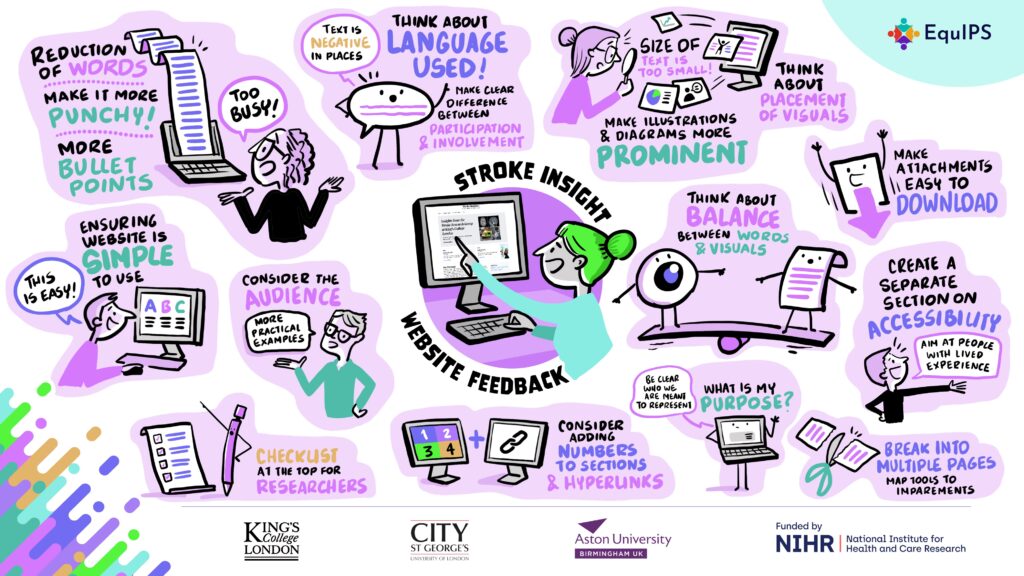
In October 2026 we held a wider consultation workshop, bringing people together to read and challenge a draft of that guidance. Some of that feedback was captured by Felipe Caro, and is shown below.
We are taking this work to the UK Stroke Forum in December 2026, where we are running a panel on involving stroke survivors with more severe impairments in research.